
Walk to School Day: Is My Child Ready to Walk to School?
Have you seen the map that shows how, over generations, children’s independent travel has steadily declined?
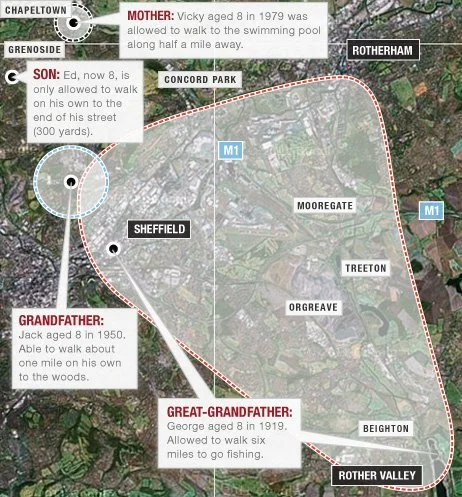
Children are walking less, spending more time indoors, and increasingly engaging with screens.
Which raises an important question:
How is this shift impacting children’s mental and physical wellbeing?
On May 22 it’s National Walk to School Day across many schools in Australia — a great initiative designed to encourage movement, independence, and community connection.
However, it also brings forward a wider conversation about safety messaging and childhood independence.
On many school posters, National Road Safety guidance states that children under 10 should hold an adult’s hand when crossing the road.
While this message is clearly focused on safety, it also contrasts with growing conversations in child development and parenting research about independence and readiness.
In collaboration with Adelaide paediatric psychologist Dr Terence Sheppard, the Milestones to Maturity project is being developed — a practical Positive Parenting framework designed to help families understand when and how children build independence in everyday life.
Is my child ready to walk to school?
This is one of the most searched and commonly asked parenting questions today:
Is my child ready to walk to school alone?
What age is safe to walk to school?
When can children start walking to school independently?
How do parents know if a child is ready for school independence?
There is no single answer based on age alone. Readiness is shaped by maturity, environment, distance, and opportunity.
Within developmental frameworks like Milestones to Maturity, many children may be ready to begin walking to school independently between 8–10 years old, depending on individual circumstances.
What research shows about children walking to school
Over recent decades, children’s independent mobility has significantly declined.
In Australia, studies suggest that fewer than one-third of primary school children now walk or ride to school regularly, with increasing reliance on car transport becoming the norm (Adelaide Now).
Research also shows that independent mobility has declined sharply since the early 1990s in many Western countries (Monash University Research).
At the same time, independent movement is consistently associated with positive developmental outcomes, including:
higher physical activity levels
improved confidence and decision-making skills
stronger social development
greater connection to community environments (BMC Public Health)
In simple terms: independence supports capability development.
What children may be losing
Children are often more capable than they are given credit for.
However, capability develops through experience, not instruction alone.
Regular opportunities for independence — such as walking to school, navigating familiar routes, or making small decisions — help build confidence and resilience over time.
A common observation from families is how quickly children adapt when given responsibility in safe, supported environments.
Why aren’t children walking to school as much anymore?
The decline in walking to school is influenced by several factors, including:
traffic safety concerns
longer commuting distances
busy family schedules
reduced walkable infrastructure
increased parental anxiety about risk
In contrast, countries such as the Netherlands maintain far higher levels of active school travel, with children commonly walking or cycling independently from a young age.
This difference raises an important question:
How much of childhood independence is shaped by environment and culture, rather than capability?
Safety and independence do not need to be opposites
This is not a conversation about reducing safety.
Rather, it is about finding balance.
Children need:
safe road environments
lower traffic speeds around schools (often 40km/h zones are recommended in school precincts)
driver awareness during school hours
well-designed pedestrian infrastructure
They also need gradual, supported opportunities to build independence.
A more useful set of questions
Instead of only asking:
“Is it safe for my child to walk to school?”
It can also be helpful to ask:
Is my child developing independence skills step by step?
What opportunities exist to build confidence in everyday environments?
How is independence being supported in daily routines?
Are protection and preparation in balance?
Final reflection
Children do not develop confidence simply by being told they are capable.
They develop it through repeated experience, responsibility, and trust.
Independence is not a single milestone — it is a gradual process built one step at a time.
And sometimes, it begins with something as simple as walking to school.
For more information about Milestones to Maturity, visit https://www.positiveparenting.au/resilience-milestones
Further reading:
Independent mobility and child development: https://bmcpublichealth.biomedcentral.com/articles/10.1186/1471-2458-14-91
Trends in children’s independent mobility: https://research.monash.edu/en/publications/australian-childrens-independent-mobility-levels-secondary-analys/
Child active travel research overview: https://research.acer.edu.au/cimat/5